An AI memory app for iPhone
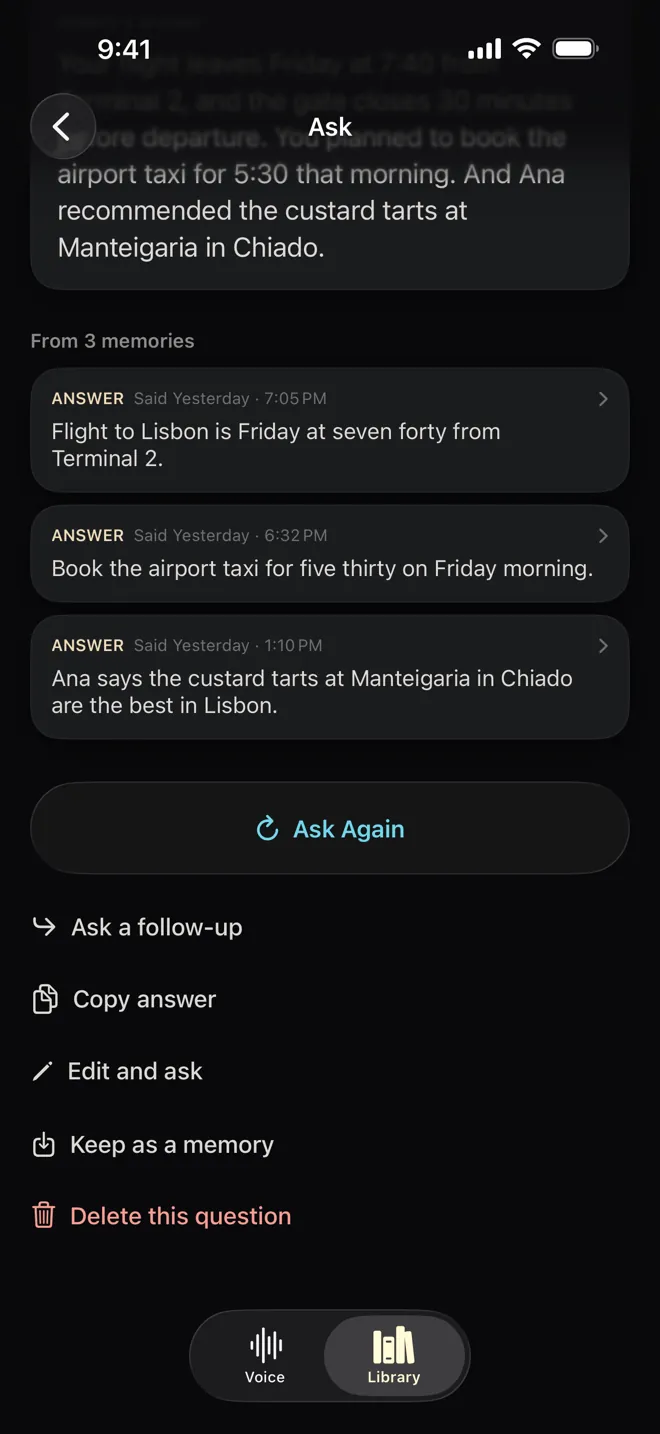
Short answer: Mmory remembers what you deliberately tell it. You say or type a thought, and later you ask for it in your own words. It answers from what you saved and shows which memories it used. It doesn't listen in the background, and it only knows what you've given it.
The problem it's for
Small details are easy to lose: where you parked, what a friend recommended, what to pack, an idea you had on a walk. Writing them in a notes app works until you can't remember where you put them, or what you called them. Mmory's answer is to skip the filing and ask later.
How it works
- Tell it. Hold to speak or type. Quick capture from a widget or Lock Screen control opens the app already recording.
- Mmory keeps it. It transcribes on your iPhone and adds the memory to a search index on the device.
- Ask. Use everyday language. You don't need the original words or to remember which note it was.
- Check. The answer lists the memories behind it, and you can open each one.
Good questions to ask it
- “Where did I park?”
- “What did Sarah recommend?”
- “What do I need to pack for Dallas?”
- “What was that idea I had yesterday?”
Questions never use one of your saves. You can also search or browse your Library, and if you want a nudge rather than an answer, say “remind me” with a time.
What the answer looks like depends on your iPhone
| Your iPhone | How Mmory answers |
|---|---|
| iOS 26 or later, with Apple Intelligence available | Apple's on-device model writes the answer |
| Enough memory for Mmory's private AI model, once downloaded | The model runs on the iPhone and writes the answer |
| Neither of these | Mmory quotes the relevant memories back to you |
Apple Intelligence isn't required. If a memory holds the exact detail you asked for, Mmory can give it to you directly on any of these iPhones. Questions that need a written answer can come back plainer on some iPhones. More on this in on-device AI notes.
Is it a second brain?
Partly. It's good for the capture-and-recall half: getting a thought out of your head quickly and finding it again. It isn't a knowledge base. There are no links between notes, no folders, and nothing flows into Obsidian or another vault. If your notes need to end up as Markdown, use a tool built for that and treat Mmory as a scratchpad you can ask.
Who it won't suit
- Meeting recording. Each recording is capped at 5 minutes, with no speaker labels.
- Always-on capture. Pendants and meeting recorders capture things for you. Mmory records only when you ask it to. If you want to keep what someone told you, say it in your own words afterwards.
- Several devices. It's iPhone only, with no sync. Voicenotes, for example, lists macOS, iOS, Windows, Android, web and Watch apps and also answers questions about your notes.
- Existing recordings. Mmory can't import or search them.
- Other languages. It understands English only.
Mmory is a note-taking tool, not a medical product, and it isn't intended to diagnose or treat any condition. Answers can miss things or be wrong, so check the source for anything important.
Privacy
Your memories are stored on your iPhone and Mmory has no server that receives them. Private AI voice notes explains what stays on the device and what does connect.